
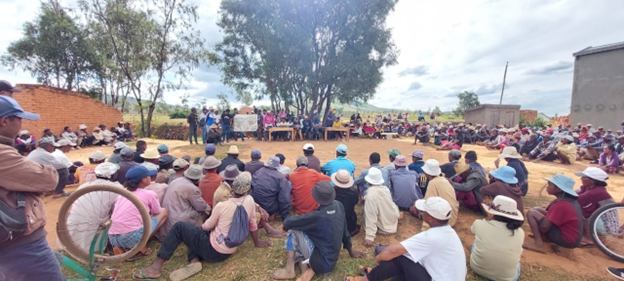
The consortium formed by IGN FI and Geosystems has launched land certification and land office support operations in Madagascar in the regions of Amoron’i Mania, Haute Mahatsiatra, Vakinankaratra, Analamanga, Bongolava, and Itasy.
Project funding is provided by the World Bank and will be managed by the Agricultural Growth and Land Tenure Security Project Management Unit (CASEF), under the auspices of the Ministry of Agriculture and Livestock (MINAE) and the Ministry of Land Management and Land Services (MATSF) as the technical oversight for the land tenure security operation.
Its goal is to issue a total of 346,000 land certificates by the end of the 13-month project.
To achieve this ambitious objective, the IGN FI and Geosystems teams have been fully mobilized for over two months and continue to scale up their efforts. In total, 5 international experts/project managers are mobilized to assist in the project’s implementation. They are assisted by highly qualified national and regional supervisory staff, as well as over 1,000 agents recruited throughout the project’s operational area.
Our experts are currently on a mission to define the technical roadmap with the teams, configure the tools, and then train field personnel on their use.
The use of tablets and GEOSIF, developed by GEOFIT and implemented by IGN FI on similar projects, will facilitate field operations. Concrete actions have already begun in the field, with the reception of the first 1,000 certificate applications in one day across two fokontany in the municipality of Ampitatafika (Vakinankaratra region). Other operations will follow at a sustained pace!
As in many countries, land certification is a crucial issue in Madagascar. This project, by formalizing customary and acquired rights, will enable landowners to obtain land certificates, thereby guaranteeing their rights as occupants and owners of these lands. The objective is also to promote the sustainable development of plots by enabling investments (for example, their access to banking and financial services) and fostering social appeasement (the vast majority of local disputes are land-related).
